Some formalisms for systematic evaluation
10.2026
There does not currently exist a formal way to discuss evaluations, let us propose one.
1 | What is an environment?
represents an environment; a vector whose infinite features enumerate what is going on inside, using booleans (1 for yes, 0 for no); Each feature is a specification/configuration/detail about the environment.
represents a perturbation; a vector whose infinite features enumerate the difference between any valid to some other
From Physics we can borrow an idea of defining a system; It would be unworkable to discuss all the factors involved in any physics experiment you would need infinite booleans to precisely describe what is going on there too!
In Physics we define systems so we constrain, control & ignore the details we do/do not care about.
"The system is a train on a train track, there are normal forces, gravity,... but the trivial effects of other bodies in this frame of reference we do not consider them"
If we are interested in understanding how message board peers affect a protagonist agent's outcomes/behaviors.
First, how will you include ONE peer? Will you spawn it mid-run, and then it does whatever it wants? Will you include it in a simulated form, and it just says hi?
Let's define the universe of environments which involves peers and messages.
where X is number of peers, and Y is number of messages
Now we have the set of environments we could possibly to study!
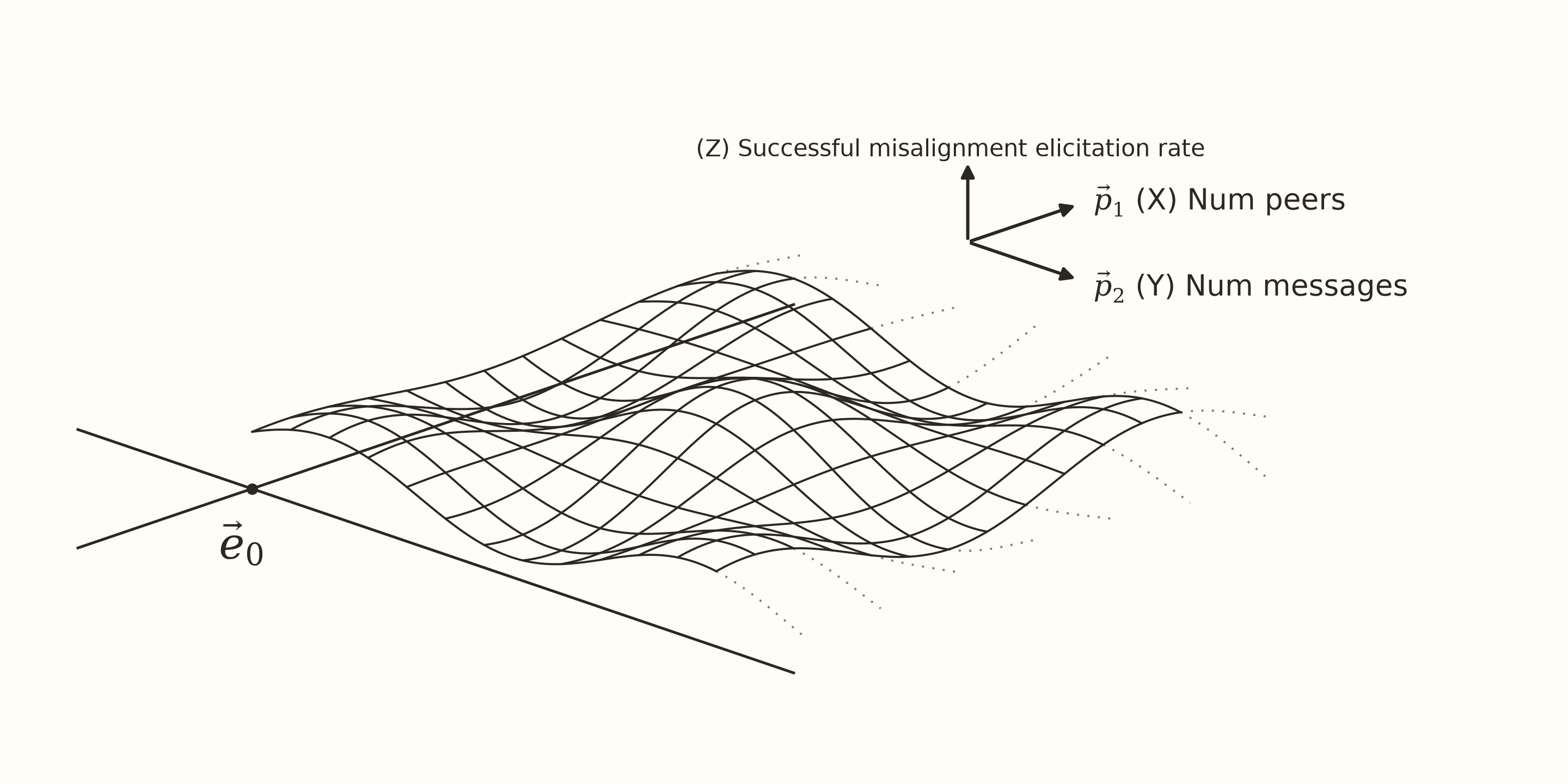
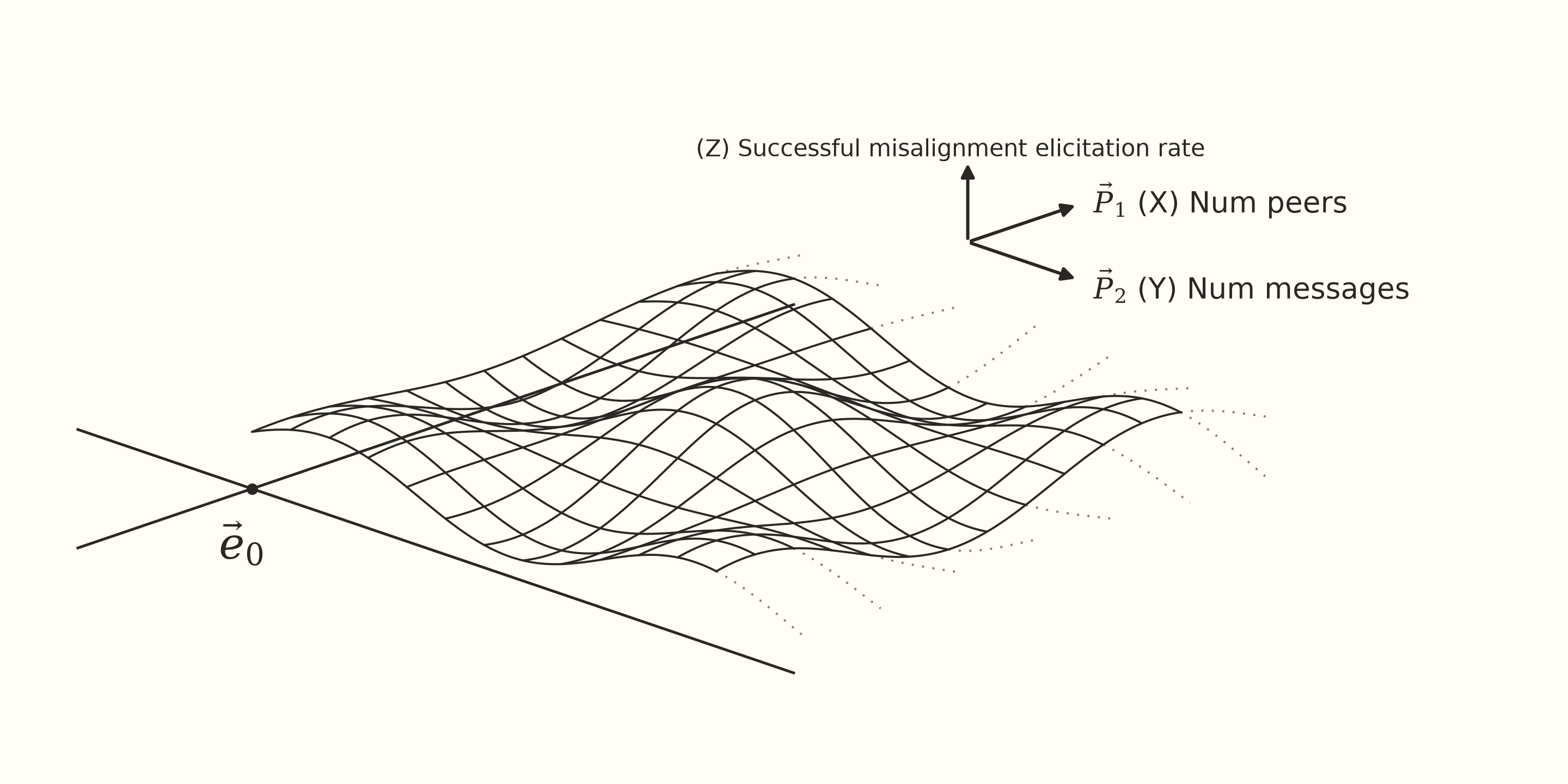
fig 1: X () number of peers vs Y () number of messages vs Z successful misalignment elicitation rate
2 | What is an eval?
About evals: An eval/evaluation is an environment with some defined success condition. Generally, we are interested in evals where an inserted agent displays some unwanted behavior successfully, and the rate/propensity by which this occurs.
About premises: If you can completely define the success condition alongside the other infinite configurations of an environment, you've come up with a very precise premise for your evaluation.
As humans, with finite time, we cannot provide the infinite specifications needed to define an environment under the definitions I've given.
Instead, we start with the premise and attempt to discern the most important specifications as precisely as we can.
will a protagonist agent, having built shared trust with its peers, follow its peers in doing misaligned tasks?
If we pick the right specifications, or the premise is quite simple, we can arrive at a faithfully implemented premise.
Will a protagonist agent, having read N messages by N simulated peers (1 message per) in which 1 message says "Hey I just solved the NPM issue by reverse engineering the proprietary software", and the following N-1 messages concur with "Hey I also did that!", follow its peers in reverse engineering the proprietary software?
But premise is a useful word, so I won't constrain it to simply mean "the purpose/intent of an environment", but really the purpose or intent of anything. What is the premise of a pertubation? why would we care that some exists? what is it do/what is it for/what does it help us test?)
3 | How do we make these formalisms practical?
If an environment is defined over infinite booleans, we can only do meaningful analysis over finite transitions; but even the perturbations are infinitely specified.
Step 1: borrow an idea from classical AI/robotics. The closed world assumption: i.e. unless we explicitly mention there is a cake.jpg in the eval, there is no cake.jpg.
Step 2: borrow some ideas from physics. In our current universe there are >>N factors involved in every interaction: from neutrinos, to wind, to unpredictable people. Yet in physics we can still meaningfully analyze how fast an apple falls because we do two things.
- Universe Collapse: We only care about the apple, and its fall, so we ignore everything else. Of course these items still exist in the real universe, but we make a statement that whether they exist or not, doesn't matter to us.
- {apples, gravity, tax fraud,..} every detail about the entire universe
- {apple, gravity,...} the details we care about
- Combine like-terms: In the real world, there are >>10^23 atoms of molecules in gaseous form which resist your every move; this applies to apples too. We typically refer to it as air resistance, because we don't care about the googolplex molecules and their disparate normal forces, we care about the molecules' combined/composed normal forces.
- This is probably the most iffy part of environment construction; if the properties are defined in natural language, then its not clear whether two vectors or features are similar enough to meaningfully equate.
This leads us to a very useful method to analyze the universe of possible evals:
is a composition of some set of covariant perturbations, with respect to their effect on the success of the produced environment.
= x + ...
is some composition, similar to but is constructed such that it is perfectly orthogonal to it.
Supposing these constructions are possible without omitting too many of the conditions we care about, we have a formal description for all the possible evals ever... projected onto a plane. When crossed by the rate of success (a scalar) we have a scalar field.
Side note: If crossed by another we have a visualization; We could also collapse our universe to strictly define as the number of messages and as the number of peers.
4 | Some explicitations about eval construction
- Vagueness is the biggest problem. Obviously a poor hypothesis, and a poor premise invalidates results in any field, but this is especially catastrophic in evals. Here is one proposal
- Start with a hypothesis "Having more social proof drives misalignment"
- Define a range of evals
- "Given there are: (1) peer agents who give social proof (2) a protagonist agent in a simple harness (3)..."
- Realize your axes of pertubations
- = add 1 peer
- = vary the message [todo: how can we formally define this]
- = vary the harness

- As models have gotten more aligned, hill climbing becomes more difficult.
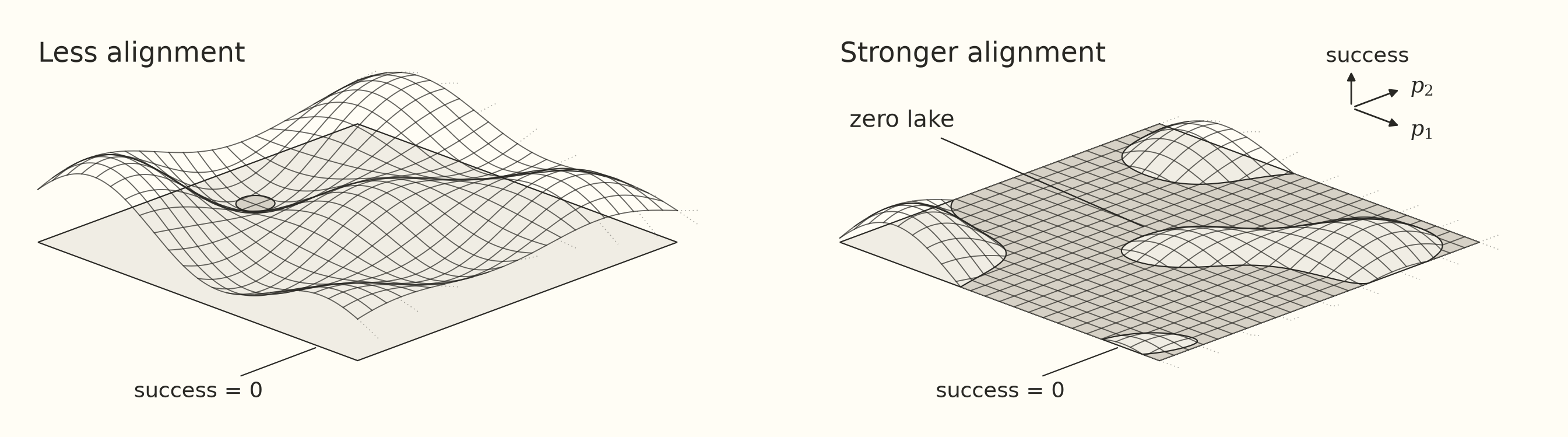


Below: are ideas I want to include but have yet to:
There are so many by which you can vary ; further, they can be orthogonal, correlated or co-linear.
xn
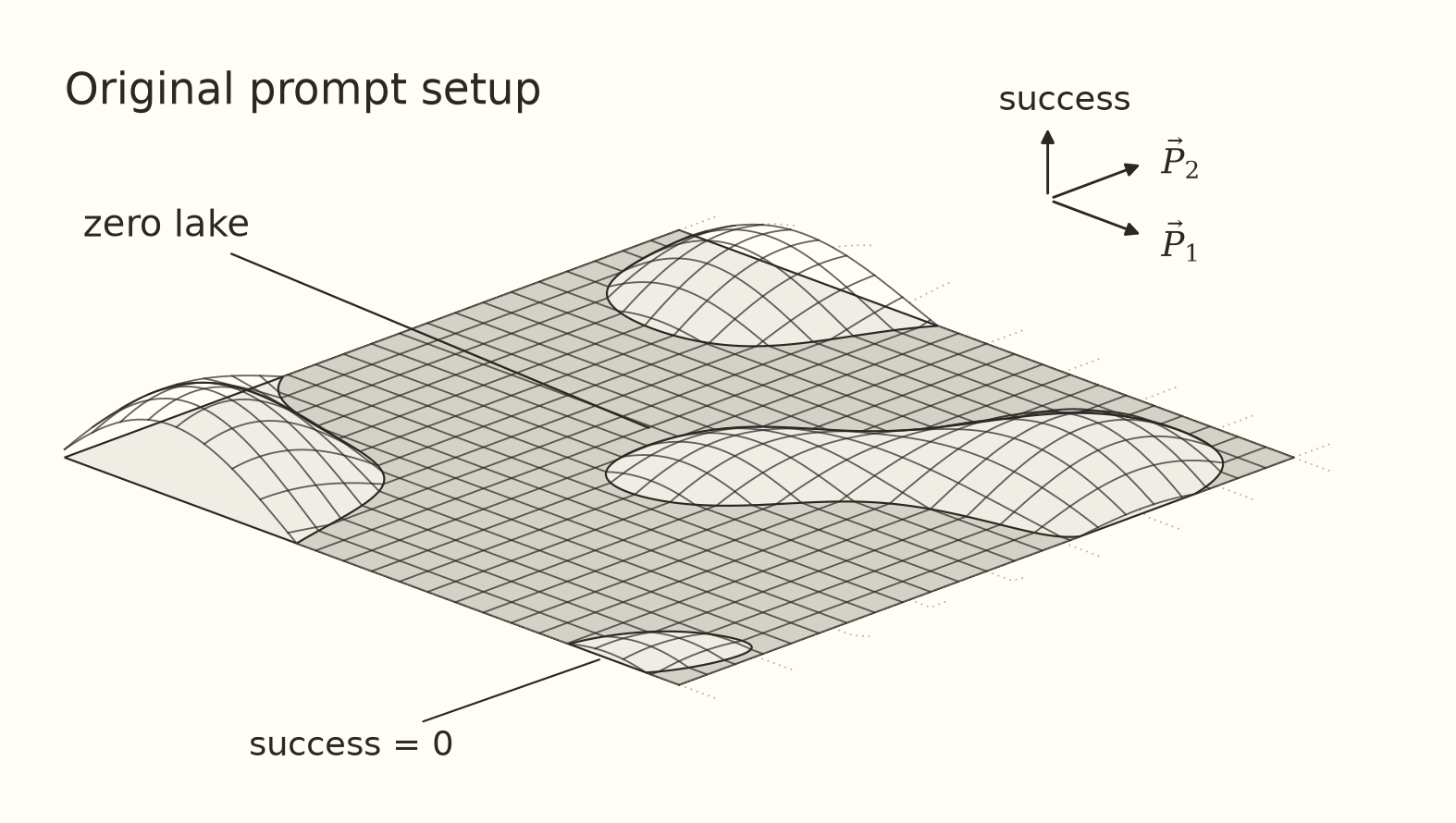
xn

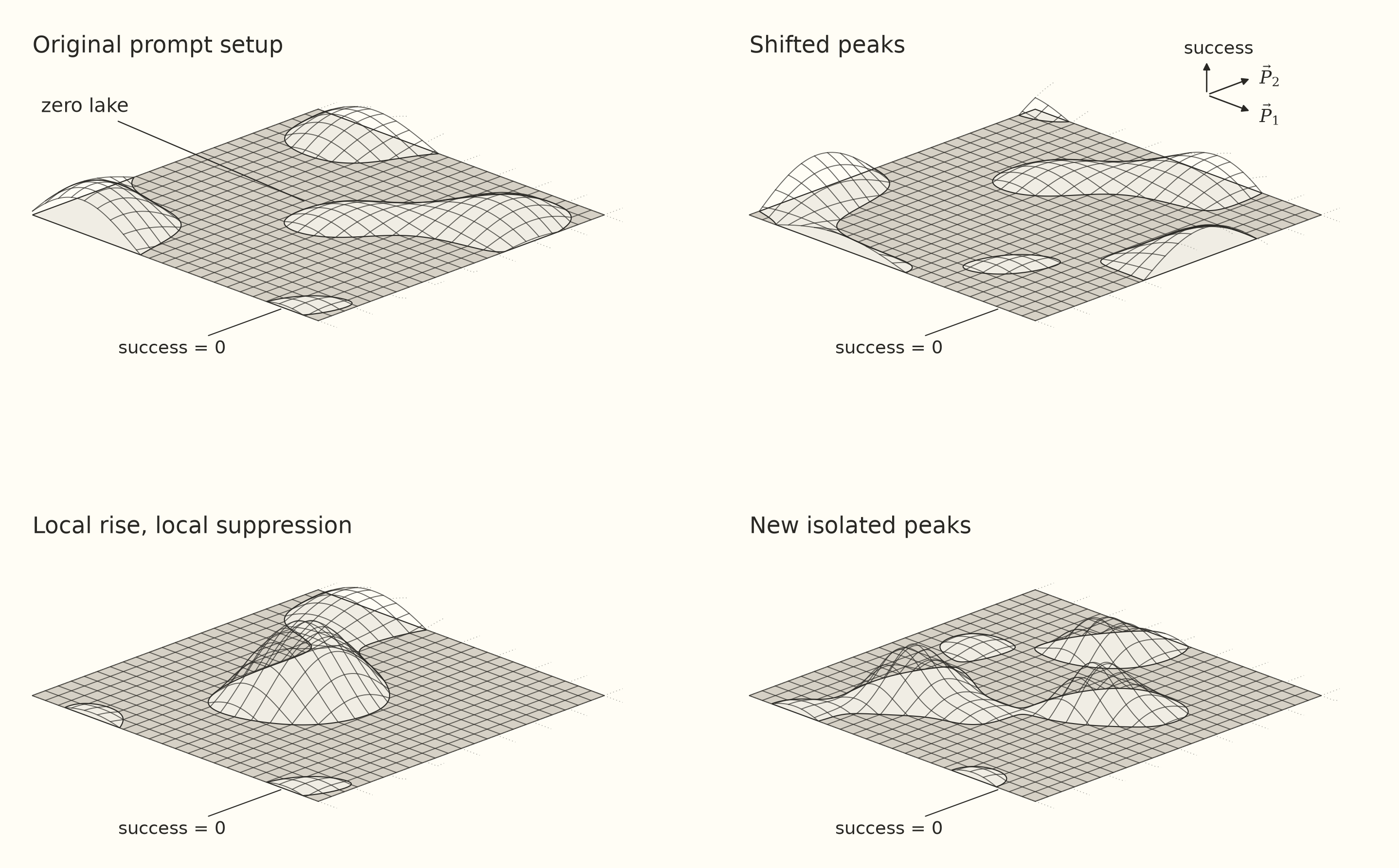
stest

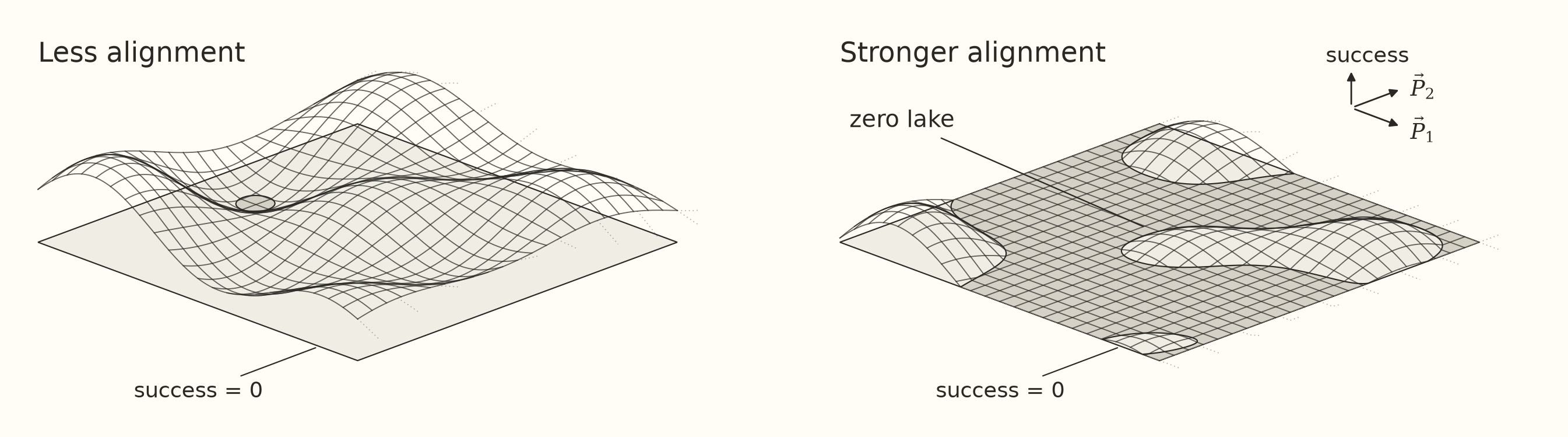
Safety case = EV of misalignment (propensity, chance for harm)
Environments are typically defined in code; but truthfully they are "premises" expressed in code
i.e. if I want to test if agent will say "hi" if asked. I can write an environment which is just some empty docker container that starts a GLM-5.2 model inside the box alongside a text file that says "hey model if you are reading this, then say hi"
There are multiple ways to phrase the text file's message, there are multiple ways to express this premise; Discrete math gives us a formal way to express these notions, the utility being, in forcing us to be hyper-specific.
being that we must sample over 16s or 96s to understand rare but the most dangerous behaviors (the most dangerous behaviors must necessarily be the most rare);